
EVERARC / SELECTED WORK / COMMERCE INTELLIGENCE
ScoutPulse
A workspace for researching Shopify competitors and comparing product catalogs.
COMMERCE INTELLIGENCE
Work or experience from members of the Everarc team
The product
ScoutPulse brings competitive store research into one workspace. A merchant can connect publicly accessible Shopify stores, select collections to inspect, compare the products in those catalogs and return to earlier research runs. The purpose is to make a repeatable research task easier to navigate than a set of disconnected browser tabs and spreadsheets.
A useful research flow
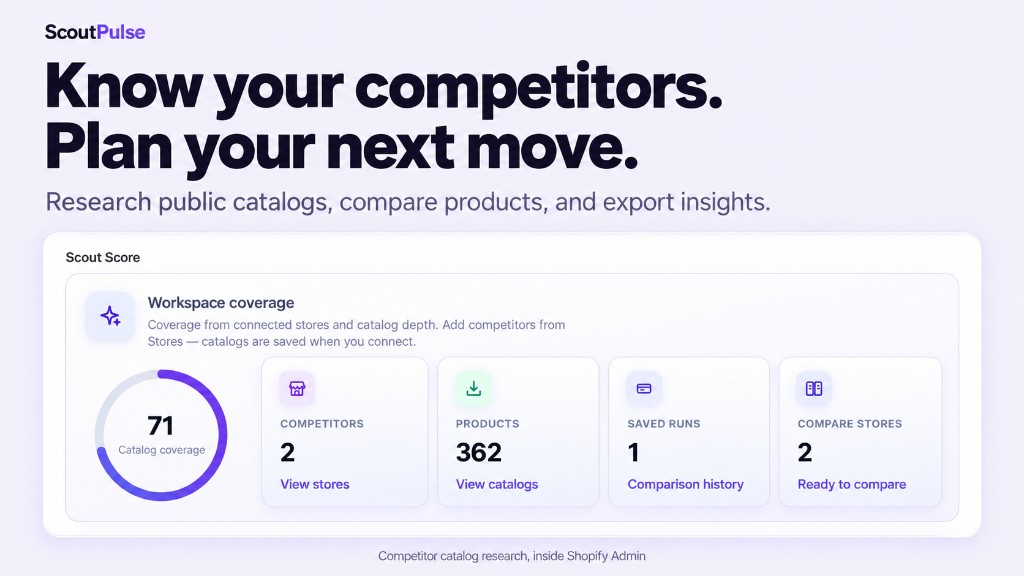
The core flow starts with a store and the collection a user wants to examine. From there the interface supports comparison across catalog records, review of previous runs and export of findings. The dashboard screenshot above shows the actual product; it is used here so visitors can judge the interface rather than an imagined mockup.
What matters in a tool like this
A comparison is only useful when its sources and scope are clear. Product selection, collection boundaries, comparable fields and the ability to revisit a run all shape whether the output can guide a decision. The product is presented as a research aid; it does not promise a particular revenue outcome.
DEEPER INTO THE PRODUCT
The user journey
The merchant starts by choosing competitors rather than starting with a chart. A store connection identifies the public catalog to examine; collection selection narrows that catalog to a product group with a clear comparison purpose. The comparison view then gives the user a place to inspect what appears across stores. Past runs provide continuity, while export moves a documented set of findings into the team’s own analysis. These are the product steps represented in the live ScoutPulse experience.
What the interface has to make clear
A research tool should not blur the line between a store’s published product information and an interpretation of it. A user needs to see which competitor and collection a record belongs to and understand whether the comparison covers the same category on each site. If product naming is inconsistent across stores, the interface should expose that context instead of implying that similarly named items are identical. These considerations explain the decisions behind the research workflow; they are not claims that a particular matching algorithm has been independently audited.
Why saved research matters
Competitive catalogs change. A saved run is useful because it records what the team chose to compare and lets them return to that view later. An export is useful for sharing and further work, but its value depends on retaining enough context to interpret the results. ScoutPulse combines the run history and export steps with the comparison itself rather than treating data collection as the end of the job.
The evidence and the limits
The dashboard on this page is an image of the real product, and the linked ScoutPulse site is the public reference. This case study describes the visible workflow and the team’s product experience. It does not claim that we measured a merchant’s sales uplift, improved scraping accuracy by a particular percentage or delivered every part of the business’s operations.
IMPLEMENTATION NOTES
Research scope before data collection
A catalog research run begins with a decision about scope: which competitor stores and which collections should be compared. The practical goal is to compare products that answer the same commercial question. For instance, looking at a seasonal collection in one store and a storewide catalog in another can produce a large export without a meaningful comparison. Choosing the boundary first saves time when the findings are reviewed.
From a public store to a usable workspace
The ScoutPulse product flow brings publicly accessible Shopify catalog data into a structured research experience. Store selection, collection comparison, previous runs and exports belong to one workspace. A user can return to a prior investigation instead of having to reconstruct what they searched for. The dashboard image shows the live product interface, while the website link lets visitors inspect the current experience.
Interpreting results carefully
A product title alone may not make two products equivalent. Catalogs have different option structures, bundles and merchandising language. A useful tool should support review by a human who understands the category. This is why the case study describes research and comparison rather than promising automated certainty or attributing an unverified revenue gain to a merchant.
What an agency client can take from it
This project illustrates a broader web-platform pattern: a user selects a source and scope, the application prepares information for comparison, and the result is stored in a form that can be revisited or exported. The reusable thinking is in the workflow and the data context, not in a generic “AI dashboard” label. We present the verified product steps and leave private customer numbers out of the public portfolio.
Build something useful with us.
Tell us about the product, users and constraints. We’ll suggest a sensible next step.
Start a conversation ↗