
EVERARC / SELECTED WORK / PASSIVE SAFETY
Still Blinking?
A passive check-in concept for people living alone and the people who care about them.
PASSIVE SAFETY
Work or experience from members of the Everarc team
The product
Still Blinking? uses ordinary phone activity as a signal that a person is active. The public app description says that when activity stops, a Care Circle can receive a gentle alert. It is designed to avoid daily check-in buttons and does not describe continuous GPS tracking as part of that flow.
Designing for a sensitive moment
Safety products need clear expectations. A caregiver should understand what an alert means, and the person being monitored should understand which signals are used. Notification copy needs to avoid implying certainty about someone’s condition from the absence of phone activity alone.
The visible experience
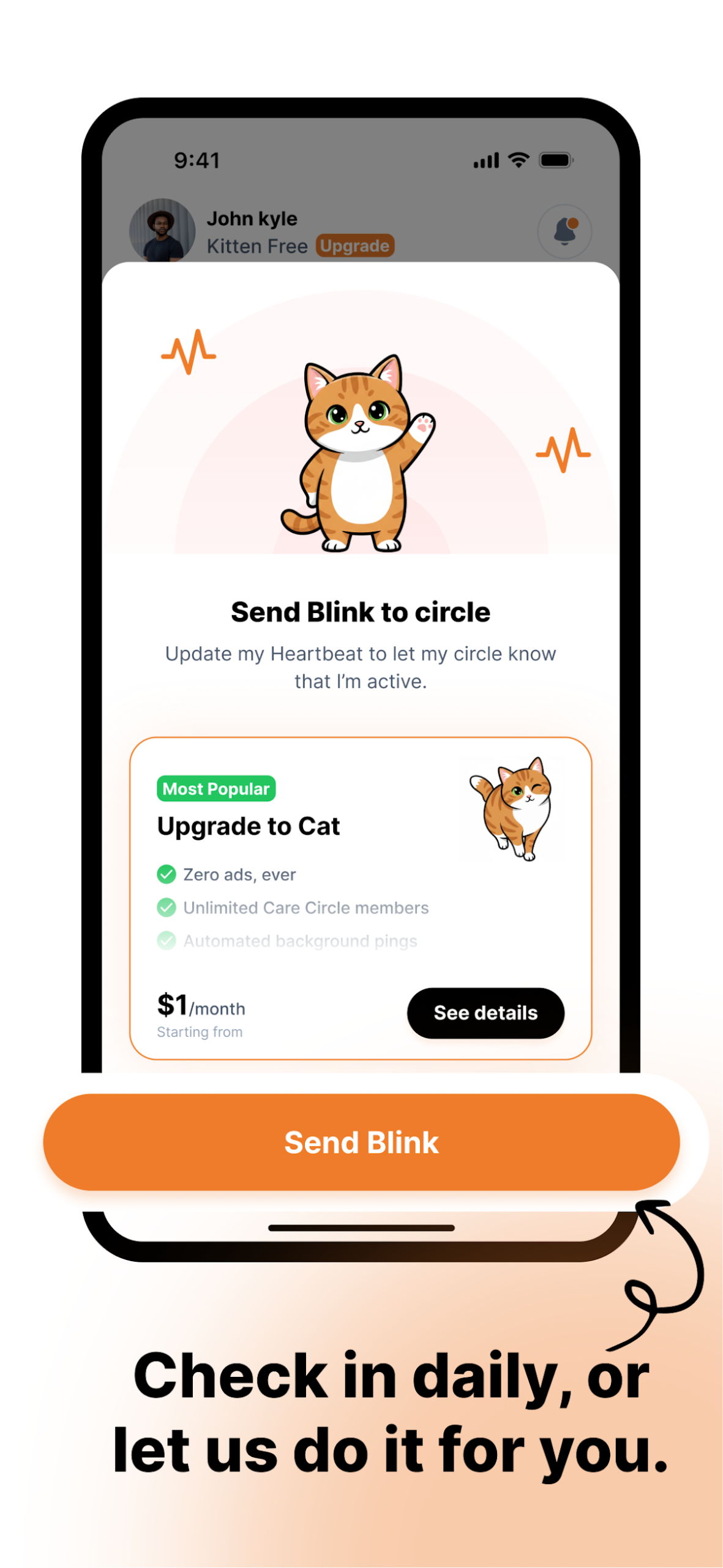
The app’s published listing addresses independent living, older adults, family members and solo travelers. The image above is a real app screenshot. The feature description here follows the public listing and does not claim that the app replaces emergency services or guarantees detection of an incident.
DEEPER INTO THE PRODUCT
A passive check-in instead of another task
Still Blinking? describes a safety check-in that uses ordinary phone activity as a signal. The public listing says a Care Circle can receive an alert if those signs stop. The premise removes a repeated manual action for a person who lives alone. It also changes the burden on the interface: users and caregivers need to understand what activity means, when the system alerts and what an alert does not establish.
A gentle signal with serious consequences
The absence of device activity is not a diagnosis or proof of an emergency. The monitored person may simply be away from their phone. Alert wording needs to communicate uncertainty so a family member can make an informed response. At the same time, an alert should be easy to notice and follow. This is a design consideration drawn from the product’s public premise, not a claim about a measured alert rate.
Privacy and autonomy
The app listing emphasizes a flow without daily check-in buttons or GPS tracking. That is an important part of its intended experience: support independent living without demanding constant manual reassurance. The listing’s broader data-safety disclosures should still be read by a prospective user, because not using GPS in a described feature is different from claiming an application never handles location data for any purpose.
Project evidence
The screenshot here is from the actual mobile app. The public store listing supports the described user journey and availability. We do not describe Still Blinking? as an emergency service or claim it guarantees a response to every incident.
Build something useful with us.
Tell us about the product, users and constraints. We’ll suggest a sensible next step.
Start a conversation ↗